Built for Safe Robots, From the Silicon Up
Lyte joins the NVIDIA Halos ecosystem, bringing LyteVision, its real-time multimodal perception platform, to help robots understand and operate safely in shared spaces.
Robots are moving into spaces designed for people: factory floors, warehouses, loading docks, and shared work cells. Safety is no longer only about separation; it requires systems that can understand a dynamic scene well enough to make safe decisions at useful speed.
No single vantage point can see the whole operating environment. Payloads block views, people enter from blind spots, and work cells change moment by moment. Closing those gaps requires dependable perception on the robot and additional viewpoints around the environment.
Today at Automate, NVIDIA announced Halos for Robotics, its full-stack safety system for physical AI. As part of the NVIDIA Halos for Robotics ecosystem, Lyte is bringing LyteVision, its real-time multimodal perception platform, into safety architectures for robots operating around people. Lyte is also joining the NVIDIA Halos AI Systems Inspection Lab, an ANSI National Accreditation Board (ANAB)-accredited inspection lab designed for physical AI and autonomous systems.
"Robots earn their place around people through dependable perception, not separation alone. Joining NVIDIA Halos lets Lyte bring its perception and functional-safety work into a shared, inspectable architecture for physical AI."
What a safety case asks of perception
A safety case asks different questions than a demo. Perception must be timely, traceable, and aligned: where objects are, how they move, and how quickly evidence reaches the decision stack. LyteVision is built for that. It measures motion directly rather than inferring it after the fact and delivers that evidence with deterministic timing and minimal end-to-end latency, because a safety decision cannot wait.
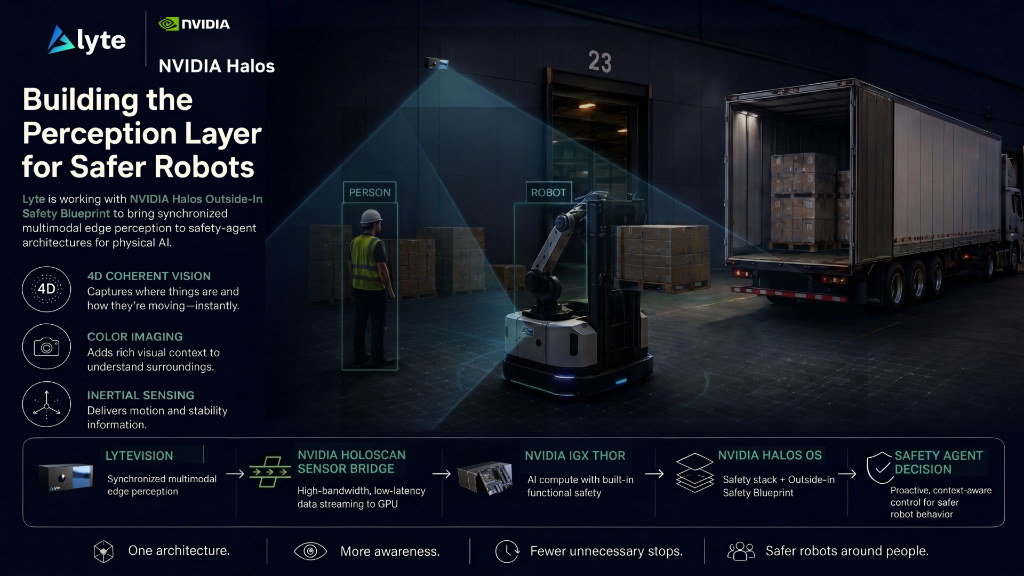
It combines 4D coherent vision, color imaging, and inertial sensing, fused at the edge on a synchronized timeline into one view of a scene, not several streams the robot has to reconcile. 4D coherent vision captures where something is and where it is going in the same instant. For a robot working near people, knowing not just where something is but where it is going is what separates reacting from anticipating.
Bringing LyteVision to NVIDIA's Outside-In Safety Blueprint
The NVIDIA Halos Outside-In Safety Blueprint extends robot perception beyond onboard sensing using external cameras and AI agents. Lyte brings LyteVision into the blueprint as a real-time perception layer that gives safety agents synchronized evidence about objects and motion in the work area. An early focus is automated trailer loading, where systems must distinguish clear space from occlusion, clutter, and a person entering the work area with fewer unnecessary stops.
This builds on Lyte's collaboration with NVIDIA on NVIDIA Holoscan Sensor Bridge, announced at GTC, which streams LyteVision's high-bandwidth multimodal data directly into GPU memory. That low-latency path from sensing to AI is now extending toward safety-critical robotics on NVIDIA IGX Thor.
Safety as an architecture
Safety does not come from one sensor, model, or rule. It comes from systems that can be inspected, tested, and trusted as a whole. NVIDIA Halos for Robotics provides a structured path. Lyte's contribution is perception that was built for safety from the ground up, not bolted on: from custom silicon, to edge fusion, to the evidence robots use to act around people. The robots moving into our workplaces will be trusted only as far as they can perceive. Perception is what Lyte builds.
About Lyte
Founded by the team behind Microsoft Kinect and Apple Face ID, Lyte builds the perception infrastructure for physical AI. Its platform combines custom silicon, multimodal sensors, and real-time software so robots and autonomous systems can measure the physical world with the accuracy that safety-critical work demands. LyteVision was named CES 2026 Best of Innovation in Robotics. Lyte is based in Sunnyvale, California. Learn more at lyte.ai.
Reach out
info@lyte.ai